
mind the gap: communication challenges in couples
A Communication Byte

As you know, communication in your relationship can be very hard at times!
Most couples who end up seeing me for couples therapy report communication to be their biggest challenge!
For every couple ever, there is a difference between what one partner says and what the other partner hears.
This gap in communication may be big or small, and it exists because no two people can ever view or interpret the same situation in the same way.

Within the gap, there are filters. Things that color the way we hear our partner and they way they hear us.
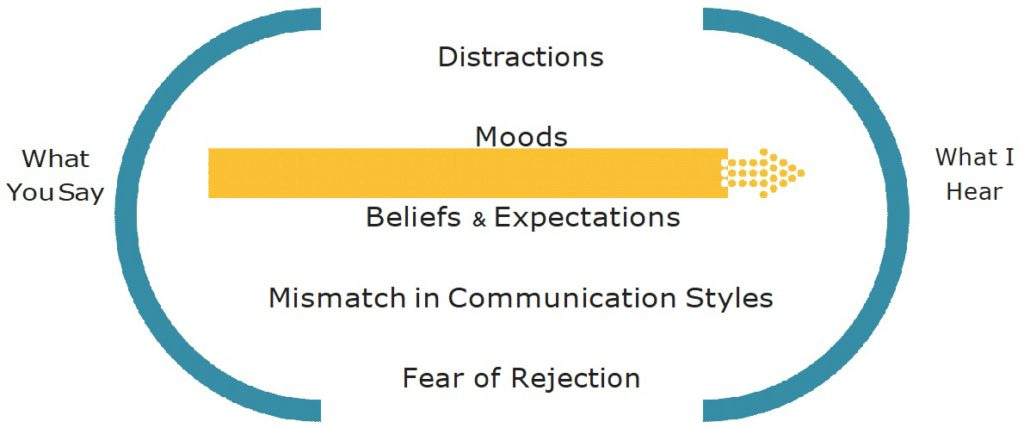
5 common filters that create communication gaps in couples:
These five are based on the classic relationship book Fighting For Your Marriage by relationship researchers Markman, Stanley, & Blumberg.
1) Distractions
Simply put, distractions include anything that takes your attention away from what your partner is communicating to you.

There may be things in your environment competing for you attention – like noisy kids or pets – as well as internal distractions making it hard to pay attention – like feeling hungry or still thinking about work.
Questions to consider:
What distractions get in your way of fully hearing your partner? How do these impact the communication between you two?
How can you minimize or eliminate these distractions during important conversations?
2) Moods
Moods can have a big impact on your relationship communication.
Not surprisingly, bad moods can really put a strain on things, making it much harder to fully hear each other and interpret what you’re hearing in a positive light.

On the other hand, good moods can help you communicate by making you more open to listening and cutting your partner some slack when they mess up.
Questions to consider:
When you’re in a negative mood, how does it impact your relationship communication? For example, do you tend to get more quick-tempered? Or ignore them altogether?
What can you do differently the next time your mood negatively impacts your communication?
3) Beliefs & Expectations
In every relationship ever, what we expect or assume to be true about our partner is what we tend to see.
A fancy psychological term for this is “confirmation bias.”
This describes something that we all do. We pay attention to things that confirm the beliefs that we already have. Therefore,
“We don't see things as they are, we see them as we are.”
-Anaïs Nin
For example, if you believe that your partner can’t be trusted – because of past partners who cheated on you, or cheating that happened in your current relationship – you may come to believe that all men/women are cheaters.
Then, you’ll tend to only see evidence that appears to confirm your belief and you’ll tend to ignore any evidence that counters it.
This can be very unfair to both your and your partner.

Personal beliefs and expectations help explain why you and your partner (and anyone else for that matter!) will never see the same situation exactly the same way. Or hear that same words in the same way!
Because of our various experiences that shape our beliefs and expectations, we all hear and interpret things differently.
So when you argue, you’re almost never arguing about facts but rather about different interpretations of facts.
Questions to consider:
What negative beliefs and expectations impact how you hear your partner?
How can you keep these beliefs and expectations in check? How would that help your communication?
4) Mismatch in Communication Styles
Couples communication is oftentimes strained simply by differences in the communication styles of partners.
These differences may be due to:
Different personality traits (e.g., introverted vs. extroverted)
Different communication styles in each of your families-of-origin (e.g., growing up in a family of loud, animated talkers),
Meta-emotion which is how you feel about your feelings and how you feel about emotional expression (e.g., “I wear my heart on my sleeve” or “I’m stoic”), and
Any other factors that make you and your partner different from one another in how you naturally communicate.
When you have different communication styles it may, at times, widen the gap in communication between you two. You may very well interpret something your partner says in a very different way than how she meant it.

Questions to consider:
How would you describe your personal communication style? And how would you describe your partner’s style?
Are there times when your style clashes with your partner’s and creates communication problems? How can you work with this toward better communication?
5) Fear of Rejection
Communication can go wrong when you or your partner don’t clearly communicate what you feel or need, and hold back what’s happening beneath the surface.
You two might fear of each other’s reactions, or fear of being rejected by one another other.
When we communicate in unclear or passive ways, we are often trying to self protect.
By hiding our true feelings, we can preserve our own self-esteem and try to shield ourselves from being hurt or rejected. We often to do this without even realizing it.
However, this filter creates a communication gap and can lead to lots of misunderstandings.
Being more assertive in your communication (not aggressive… there’s a difference!) helps with this filter.

Questions to consider:
Are there times that you have a fear of being rejected by your partner? If so, how does it tend to impact your communication with him or her?
How can you communicate in more assertive ways with your partner while also showing love and respect?
If this article helped you please leave a like! ❤
Also, comments are welcomed and encouraged here!